Can You Be a Pilot With Anxiety? Mental Health Resources
Can You Be a Pilot With Anxiety? Mental Health Resources for Pilots
Anxiety can affect people in nearly every profession, including aviation. For pilots, however, concerns about anxiety may come with an additional question: Could this affect my ability to fly?
The answer is not automatically yes or no.
Having anxiety does not necessarily prevent someone from becoming or continuing to work as a pilot. The FAA encourages pilots to seek help for mental-health concerns and notes that most treated mental-health conditions do not automatically disqualify someone from flying. Medical certification depends on the individual diagnosis, symptoms, treatment, medication use, stability, and overall ability to safely perform aviation duties.
Understanding how anxiety can affect pilots—and knowing when and where to seek appropriate support—can make the subject much less intimidating.
Can You Be a Pilot With Anxiety?
Yes, it may be possible to become or remain a pilot while experiencing anxiety.
The FAA currently recognizes several anxiety-related conditions within its medical-certification process, including generalized anxiety disorder, situational anxiety, unspecified anxiety, and social anxiety disorder. These conditions are evaluated according to specific criteria rather than being treated as an automatic disqualification in every case.
What matters is the individual situation.
For some pilots, anxiety may occur during a particularly demanding period, such as recurrent training, a career transition, family stress, or a major life change. For others, anxiety may be more persistent and require professional treatment.
The key question is whether symptoms interfere with concentration, judgment, sleep, emotional stability, communication, or the ability to safely carry out flight duties.
What Can Anxiety Look Like for a Pilot?
Anxiety does not always mean having a panic attack.
For pilots, it may appear in more subtle ways, including:
repeatedly second-guessing decisions;
excessive worry about making a mistake;
difficulty sleeping before a flight or evaluation;
muscle tension or physical restlessness;
racing thoughts about future flights;
repeatedly replaying minor errors;
difficulty mentally switching off after work;
fear surrounding checkrides or recurrent training;
irritability or difficulty concentrating;
avoiding situations that previously felt manageable.
A certain amount of nervousness or stress can occur in any demanding profession. The concern becomes greater when anxiety is persistent, worsening, or beginning to affect daily functioning.
Why Aviation Can Create Anxiety
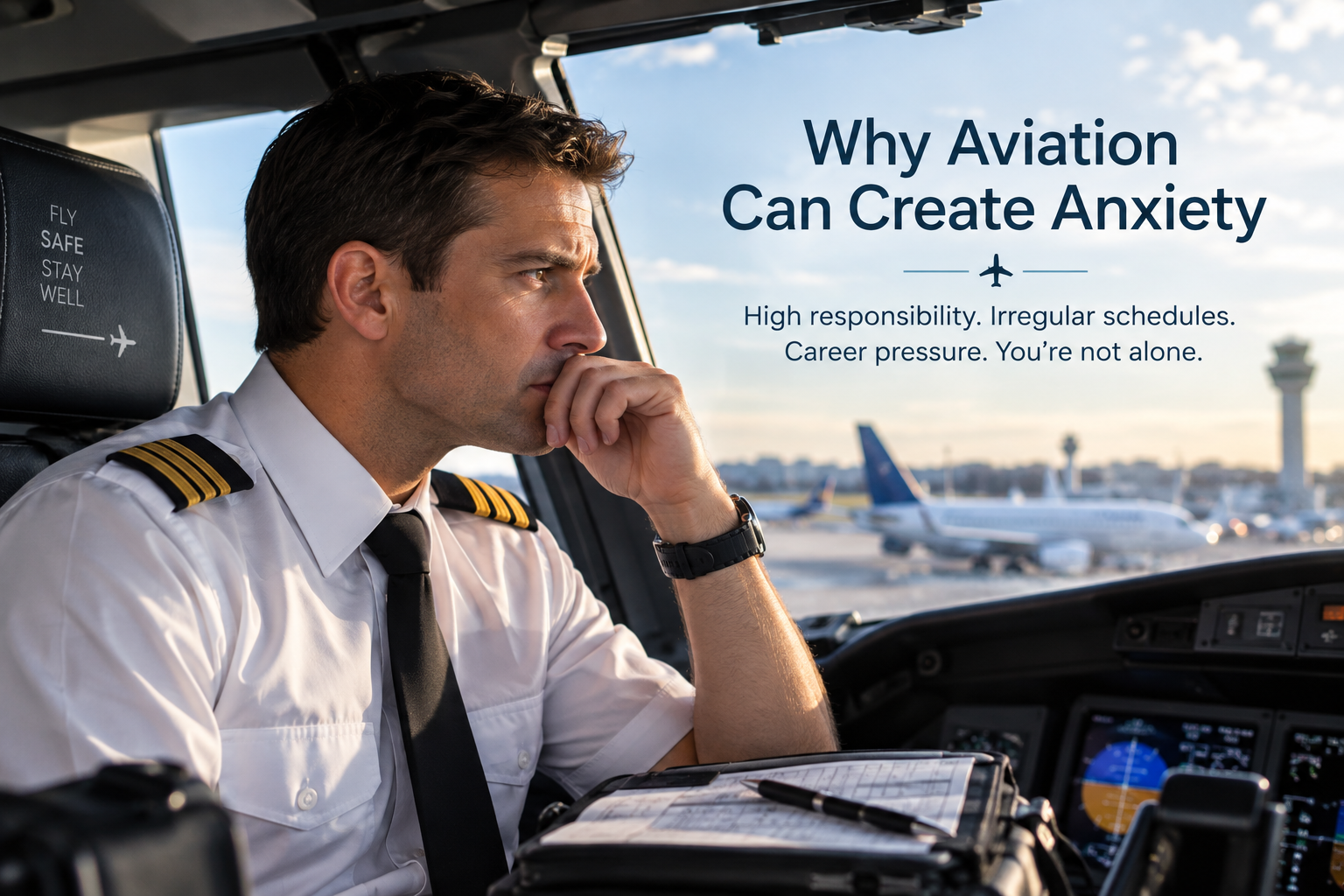
Pilots work in an environment that requires responsibility, preparation, sound judgment, and consistent performance. Several aspects of aviation may contribute to anxiety.
Pilots looking for practical strategies for managing occupational stress can also explore these flying stress relief tips.
Performance Pressure
Checkrides, recurrent training, evaluations, and career advancement can create significant pressure.
For some pilots, the problem is not lack of preparation. Instead, anxiety begins to distort how they interpret normal performance challenges.
A thought such as:
“I need to do well on this evaluation.”
can gradually become:
“If I make one mistake, everything will go wrong.”
That shift can make a stressful situation feel much more threatening than it actually is.
Irregular Schedules and Fatigue
Early departures, overnight flying, changing schedules, and crossing time zones can also affect mental well-being.
Fatigue is particularly important because inadequate rest can make it harder to regulate emotions, concentrate, and manage ordinary stress.
Career and Certification Concerns
Pilots may also become anxious about anxiety itself.
Some worry that acknowledging symptoms or speaking with a therapist could automatically threaten their medical certificate. That fear can make people reluctant to seek support even when it could be helpful.
Current FAA guidance is more nuanced than that.
Can Anxiety Affect an FAA Medical Certificate?

Yes, anxiety can affect FAA medical certification, but it does not automatically result in denial.
The FAA evaluates psychiatric conditions based on the specific diagnosis, history, symptoms, treatment, medication use, stability, and potential aviation-safety implications. Its current guidance includes dedicated pathways and decision tools for anxiety, depression, and related conditions.
Some cases may be handled by an Aviation Medical Examiner under established criteria. Other situations may require additional documentation or review by the FAA.
That is why statements such as “pilots with anxiety cannot fly” are overly broad.
The correct answer depends on the individual circumstances.
Pilots concerned about their medical status should use current FAA guidance and speak with an Aviation Medical Examiner rather than relying solely on online advice.
Can Pilots Go to Therapy?
Yes.
In May 2026, the FAA published updated guidance specifically addressing therapy, psychotherapy, and counseling for pilots and air traffic control specialists. It states that aviators can seek therapy and encourages them to get help early before concerns become more severe. The guidance identifies anxiety, mood symptoms, stress management, relationship challenges, life transitions, and personal development among reasons someone may seek therapy.
Going to therapy does not by itself mean a pilot is unable to fly.
The more important considerations are the underlying condition, symptoms, treatment, medications, and whether the individual can safely perform required duties.
Pilots should still answer medical-certification questions accurately and follow current FAA reporting requirements.
How Therapy Can Help Pilots With Anxiety
Therapy can provide a structured place to understand what is driving anxiety and develop more effective ways of responding to it.
For aviation professionals, therapy may address concerns such as:
performance anxiety;
checkride or evaluation stress;
perfectionism;
fear of making mistakes;
difficulty recovering after demanding flights;
repetitive or intrusive thoughts;
relationship stress;
career transitions;
work-life boundaries;
concerns surrounding aviation medical certification.
One approach that may be useful is Cognitive Behavioral Therapy, or CBT.
CBT examines connections among thoughts, emotions, and behaviors. It can help someone identify patterns of thinking that intensify anxiety.
For example:
“If I make one mistake, I am going to fail.”
might be examined and replaced with a more balanced thought:
“I need to prepare carefully, but one imperfect moment does not determine my entire ability or performance.”
The purpose is not forced positive thinking. It is learning to evaluate stressful thoughts more accurately.
Pilots who want more individualized support can also learn more about therapy for pilots and aviation professionals.
When Anxiety May Mean a Pilot Should Not Fly
There is an important difference between experiencing anxiety and being impaired by anxiety.
A pilot should take symptoms seriously when they interfere with the ability to operate safely.
That may include situations involving:
severe panic;
significant difficulty concentrating;
impaired judgment;
extreme emotional distress;
substantial sleep deprivation;
inability to complete routine tasks safely;
medication side effects that impair alertness or performance.
Pilots have an ongoing responsibility to assess whether they are fit for duty.
When symptoms may affect safe performance, the appropriate response is not simply to push through them. Current medical guidance should be followed, and an AME or healthcare professional should be consulted when appropriate.
Mental Health Resources for Pilots
Pilots dealing with anxiety have several possible sources of support.
Aviation Medical Examiner
An AME can help explain how a diagnosis, treatment, or medication may relate to FAA medical certification.
This can be especially valuable for pilots who are delaying care because they are uncertain about the certification process.
Licensed Mental Health Professional
A therapist can help pilots address anxiety, stress, performance concerns, relationships, and other mental-health challenges.
The FAA's current guidance recommends working with an appropriately licensed therapist or counselor.
A professional who understands aviation culture may also be better able to appreciate the unique pressures pilots face.
Pilot Peer Support Programs
Peer-support programs can give pilots an opportunity to speak with people who understand aviation from firsthand experience.
They are not a replacement for clinical treatment when treatment is needed, but they may provide an accessible starting point for someone who is reluctant to seek help.
FAA Mental Health Resources
FAA guidance changes over time, so pilots should refer to current FAA materials when questions involve medical certification, treatment, or medication.
The FAA's Guide for Aviation Medical Examiners was most recently updated in August 2026 and includes specific resources addressing psychiatric conditions, anxiety, therapy, and medication.
When Professional Support May Help
Not every period of nervousness requires therapy.
However, professional support may be useful when anxiety becomes persistent or begins interfering with:
sleep;
relationships;
concentration;
confidence;
work-life balance;
normal routines;
enjoyment of life outside aviation;
the ability to recover after stressful flights or evaluations.
Seeking support earlier may make it easier to address anxiety before patterns become more difficult to change.
Stephen Rought, LCSW provides therapy for pilots and aviation professionals, with attention to the pressures and concerns that can accompany aviation careers.
Frequently Asked Questions About Pilots and Anxiety
Can you be a pilot with anxiety?
Yes, potentially. Anxiety does not automatically disqualify someone from flying. FAA certification depends on the specific condition, symptoms, treatment, medication history, stability, and individual circumstances.
Will anxiety automatically disqualify me from an FAA medical certificate?
No. The FAA has specific evaluation pathways for several anxiety-related conditions. Some cases may be certifiable, while others may require additional documentation or FAA review.
Can pilots go to therapy?
Yes. Current FAA guidance specifically says pilots can seek therapy and encourages aviators to seek help early.
Does seeing a therapist mean I have to stop flying?
Not automatically. Therapy itself does not determine fitness to fly. The underlying condition, symptoms, treatment, medication, and ability to safely perform aviation duties are more important factors.
Do pilots have to report therapy immediately?
FAA guidance states that pilots do not automatically have to make an immediate report simply because they sought therapy. Medical history and relevant healthcare visits still need to be handled according to current FAA medical-certification requirements.
Anxiety Does Not Automatically End an Aviation Career
Experiencing anxiety does not automatically mean someone cannot be a pilot.
What matters is understanding the symptoms, recognizing when they are affecting daily functioning or flight safety, following current FAA requirements, and seeking appropriate support when needed.
For some pilots, anxiety may improve with changes in sleep, stress management, routines, and coping strategies. Others may benefit from professional therapy.
If anxiety, performance pressure, or aviation-related stress has become difficult to manage alone, therapy for pilots and aviation professionals can provide a structured place to understand what is happening and develop healthier ways of responding.
For questions specifically involving medical certification, pilots should rely on current FAA guidance and an Aviation Medical Examiner familiar with their individual circumstances.
