
Therapy Blog and Mental Health Resources
The Complete Guide to the FAA HIMS Program for Pilots
The Complete Guide to the FAA HIMS Program for Pilots
By Stephen Rought, LCSW Editorial Team · Updated 2026-07-24
The Human Intervention Motivation Study, commonly known as HIMS, is closely associated with helping pilots address substance-use concerns while meeting FAA medical-certification requirements.
For pilots entering the process, HIMS can initially feel complicated. Treatment providers, HIMS-trained Aviation Medical Examiners, evaluations, monitoring, documentation, and FAA review may all play a role.
Understanding how the process works can make it easier to know what to expect and where different professionals fit into the recovery and certification process.
Stephen Rought, LCSW provides therapy for pilots and aviation professionals in California and Florida, including pilots navigating recovery, career-related stress, and the emotional demands that may accompany FAA medical review.
What Is the FAA HIMS Program?
HIMS began as an aviation-industry program focused on identifying, treating, and supporting pilots affected by substance dependence.
Today, HIMS-trained Aviation Medical Examiners also play an important role in FAA medical-certification monitoring.
There is an important distinction:
The formal HIMS program refers to an industry program available through participating airlines.
HIMS-trained AME monitoring can also be required by the FAA for pilots who do not work for an airline participating in a formal HIMS program.
The FAA states that pilots with regulatory diagnoses involving alcohol dependence or abuse may require evaluation and monitoring before medical certification can be issued. A HIMS-trained AME can help guide the pilot through that FAA process.
HIMS-trained AMEs may also be involved in certain other certification pathways, including some cases involving antidepressant medications.
Who May Need HIMS Monitoring?
HIMS-related monitoring is commonly associated with pilots whose medical certification has been affected by alcohol or substance-use concerns.
A pilot may enter the FAA monitoring process after circumstances such as:
a substance-use diagnosis;
an alcohol- or drug-related event;
concerns identified during an aviation medical examination;
treatment for substance dependence;
FAA review of medical records;
certain psychiatric or medication-related certification situations.
Commercial, airline, corporate, charter, private, and recreational pilots may potentially work with a HIMS-trained AME when FAA monitoring is required.
Pilots who do not work for a participating HIMS airline can still be monitored by a HIMS-trained AME to meet FAA medical-certification requirements.
Whether monitoring is necessary—and what that monitoring requires—depends on the individual case and FAA guidance.
Who Is Involved in the HIMS Process?
HIMS and FAA medical monitoring usually involve several professionals rather than one provider managing everything.
Depending on the case, the team may include:
HIMS-Trained Aviation Medical Examiner
The HIMS AME plays a central role in medical certification and FAA monitoring.
HIMS AMEs receive additional training related to substance- and alcohol-related conditions and certain other aeromedical concerns. They may provide sponsorship and monitoring when required by the FAA.
Psychiatrist or Psychologist
Some pilots may be required to complete psychiatric, psychological, or neuropsychological evaluations.
These evaluations are separate clinical assessments designed to provide information relevant to FAA medical certification.
Therapist
A licensed therapist may provide ongoing treatment and support for concerns such as:
maintaining recovery;
anxiety;
occupational stress;
relationship strain;
shame or fear surrounding the certification process;
developing coping strategies;
rebuilding confidence;
managing life outside aviation during recovery.
Therapy supports the pilot's mental health and recovery. It does not replace an FAA-required psychiatric, psychological, or medical evaluation.
Peer or Sponsor
Some HIMS programs include peer support from pilots who understand aviation culture and recovery.
Substance-Use Treatment Providers
When treatment for alcohol or drug dependence is required, specialized treatment professionals may also become part of the overall recovery plan.
What Does the HIMS Process Require?
There is no single HIMS plan that applies identically to every pilot.
Requirements depend on the underlying condition, medical history, treatment progress, and FAA instructions.
For drug- and alcohol-related monitoring, requirements may include:
evaluation by a HIMS-trained AME;
substance-use treatment when required;
psychiatric or psychological evaluation;
drug or alcohol testing;
treatment-provider reports;
documentation of recovery;
continued HIMS AME follow-up;
FAA review;
compliance with a Special Issuance authorization when applicable.
The process is designed to document sustained stability and fitness rather than simply completion of a single evaluation.
How Does HIMS Pilot Monitoring Work?
HIMS pilot monitoring generally occurs over time.
The purpose is to provide the FAA with documented evidence that a pilot continues to meet the requirements associated with medical certification.
Depending on the pilot's situation, monitoring may include:
regular appointments with a HIMS-trained AME;
random or scheduled abstinence testing;
reports from treatment providers;
psychiatric or psychological follow-up;
documentation of continued recovery;
compliance with FAA Special Issuance conditions.
For some pilots with substance dependence, the FAA uses a step-down monitoring process. Monitoring requirements may change as the pilot demonstrates continued sobriety, stability, compliance, and time in the program.
A HIMS AME may be able to recommend movement between monitoring phases when FAA criteria are met, but the FAA retains oversight of certification requirements.
The objective is not simply to accumulate appointments or tests. It is to demonstrate sustained recovery and continued fitness to meet aviation medical standards.
How Long Does the HIMS Process Take?
There is no universal timeline.
Factors that can affect the length of monitoring include:
the underlying diagnosis;
severity and history of substance use;
treatment recommendations;
recovery progress;
testing results;
psychiatric or psychological findings;
compliance with monitoring;
FAA documentation requirements;
terms of a Special Issuance authorization.
Some pilots may remain under monitoring for several years.
For substance dependence, FAA guidance includes continuing follow-up and step-down monitoring rather than treating recovery as a short-term event.
Pilots should rely on the requirements provided by their HIMS AME and the FAA rather than assuming another pilot's timeline will apply to them.
What Does HIMS Cost?
There is no standard total cost because requirements vary considerably.
Potential expenses may include:
HIMS AME appointments;
psychiatric evaluations;
psychological or neuropsychological testing;
therapy;
substance-use treatment;
drug or alcohol testing;
medical documentation;
follow-up evaluations.
Insurance coverage can also vary depending on the service and provider.
Pilots should ask the professionals involved in their case what services are expected and which expenses may be their responsibility.
Is HIMS a Punishment?
No. HIMS and FAA medical monitoring are intended to address recovery and aviation safety rather than function as disciplinary punishment.
The FAA's medical-certification process focuses on whether an applicant can safely perform the duties permitted by the requested medical certificate.
For pilots who do not meet unrestricted medical standards, a Special Issuance authorization may sometimes provide a pathway to certification when the FAA determines that the individual can safely perform those duties under specified conditions.
Participation in HIMS, however, does not guarantee that a medical certificate will be issued.
Certification remains an FAA determination based on the individual case.
Common Challenges Pilots Face During HIMS
The HIMS process can affect far more than medical paperwork.
Pilots may experience:
fear about losing their career;
uncertainty about certification;
anxiety surrounding evaluations;
frustration with lengthy monitoring;
financial pressure;
relationship strain;
shame surrounding substance-use treatment;
concerns about privacy;
difficulty adjusting to time away from flying;
stress related to documentation and FAA review.
For some pilots, flying is closely tied to identity and purpose. Being temporarily removed from flight duties can therefore affect confidence and emotional well-being as well as employment.
Therapy can provide a place to work through those concerns while the medical-certification process proceeds separately.
What Does the HIMS Process Actually Require?
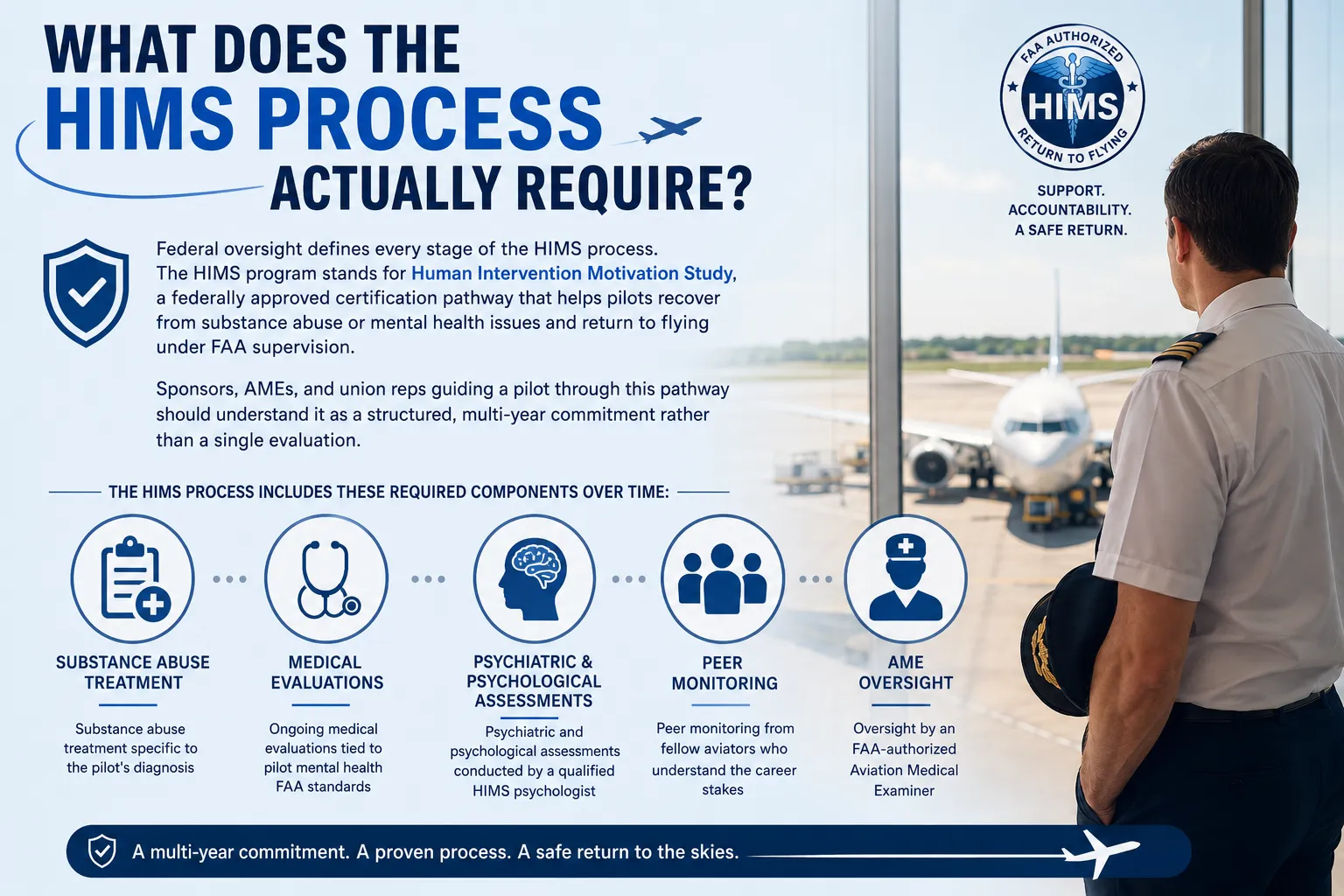
Federal oversight defines every stage of the HIMS process. The HIMS program stands for Human Intervention Motivation Study, a federally approved certification pathway that helps pilots recover from substance abuse or mental health issues and return to flying under FAA supervision. Sponsors, AMEs, and union reps guiding a pilot through this pathway should understand it as a structured, multi-year commitment rather than a single evaluation.
The program blends several required components over time, including substance abuse treatment aligned with FAA standards:
Substance abuse treatment specific to the pilot's diagnosis
Ongoing medical evaluations tied to pilot mental health FAA standards
Psychiatric and psychological assessments conducted by a qualified HIMS psychologist
Peer monitoring from fellow aviators who understand the career stakes
Oversight by an FAA-authorized Aviation Medical Examiner
How Does Therapy Fit Into the HIMS Process?
Therapy can support recovery, but it is important to distinguish therapy from FAA-required evaluations.
An FAA psychiatric or psychological evaluation is an independent assessment conducted according to applicable FAA requirements.
Therapy has a different role.
A therapist may help a pilot:
manage anxiety surrounding medical review;
maintain recovery;
develop healthier coping strategies;
address relationship or family stress;
process shame or career uncertainty;
manage occupational stress;
rebuild confidence;
maintain emotional stability during a lengthy monitoring period.
Therapy should not be viewed as coaching someone to “pass” an FAA evaluation.
Instead, it supports genuine mental health, recovery, and day-to-day functioning throughout the process.
Is Therapy Confidential for Pilots in HIMS?
Therapy is generally subject to professional confidentiality requirements, with normal legal and ethical exceptions.
However, therapy confidentiality and FAA medical-certification requirements are separate matters.
Pilots participating in HIMS or another FAA monitoring process may need to provide certain treatment records, evaluations, or progress documentation as part of their certification requirements.
The FAA's current guidance also states that pilots can seek therapy and encourages aviators to obtain help early. Simply attending therapy does not require an immediate FAA report; relevant information is addressed through applicable medical-certification requirements and the pilot's next application when required.
Pilots involved in HIMS should discuss documentation expectations with their HIMS AME and therapist so they understand what information may be required.
Can Online Therapy Support Pilots in HIMS?
For pilots in California and Florida, telehealth can make ongoing therapy easier to maintain around travel, changing work schedules, and other responsibilities.
Remote therapy may help pilots continue working on:
recovery-related stress;
anxiety;
relationship concerns;
emotional regulation;
coping strategies;
career uncertainty;
rebuilding confidence.
Telehealth does not replace required HIMS AME appointments, substance testing, psychiatric evaluations, or other FAA requirements.
It is one possible way to make ongoing counseling more accessible.
Stephen Rought, LCSW provides telehealth therapy for pilots in California and Florida and works with clients experiencing aviation-related stress, recovery challenges, and other mental-health concerns.
Returning to Flying After HIMS
For many pilots, returning to flight involves demonstrating sustained recovery and meeting FAA medical requirements.
Depending on the case, that may include:
completing required treatment;
maintaining sobriety;
meeting monitoring requirements;
completing required evaluations;
providing appropriate documentation;
receiving favorable HIMS AME recommendations;
complying with a Special Issuance authorization;
receiving FAA approval.
A Special Issuance medical certificate may allow a pilot who does not meet unrestricted standards to fly when the FAA determines that certification can be granted safely under specified conditions.
The FAA retains authority over the certification decision.
Mistakes That Can Delay FAA Medical Certification
Medical-certification delays can occur when required information or monitoring is incomplete.
Potential problems include:
missing appointments;
incomplete medical documentation;
failing to complete required treatment;
missed drug or alcohol testing;
inconsistent communication among providers;
delays in obtaining required evaluations;
not following Special Issuance requirements;
failing to submit requested FAA records.
The FAA states that failure to provide required medical information can delay issuance or result in denial of the medical application.
Maintaining organized records and regular communication with the HIMS AME can help pilots understand what remains outstanding.
What Support Helps Pilots Return and Stay Certified?
Sustained recovery depends on structured monitoring paired with consistent mental health care. Random abstinence testing, required throughout HIMS continuing care, checks recovery quality and protects the standing of a pilot's FAA special issuance medical certificate. Skipping this layer of oversight puts both flight safety and career reinstatement at risk.
Chemical dependency behaves like other chronic illnesses. It follows a primary, progressive course and carries a real risk of relapse, much like diabetes or heart disease. That reality is why ongoing support, not a one-time fix, anchors the HIMS process.
Does online therapy work for pilots with demanding schedules?
Telehealth sessions fit around irregular flight rotations without forcing pilots to choose between treatment and their careers. Research from randomized controlled trials and systematic reviews backs the effectiveness of telehealth for reducing stress.
Strong support structures for pilot substance abuse recovery typically include:
A qualified HIMS psychologist for ongoing evaluation
Regular sessions with an aviation therapist
Confidential, flexible therapy for pilots balancing rotation demands
Wellness programming supporting mental, physical, and emotional health long-term
Navigating the HIMS process demands both clinical expertise and genuine understanding of aviation's unique pressures. Therapy during this journey provides pilots with evidence-based tools to address underlying concerns, rebuild confidence, and demonstrate meaningful progress to regulators. By working with a clinician experienced in aviation-specific challenges, pilots gain the support necessary to move forward with clarity and resilience, ultimately reclaiming both their career and their peace of mind.
Mistakes That Can Delay Medical Certification
Successful completion of the HIMS Program depends on consistency, honesty, and adherence to FAA requirements. Delays often occur not because recovery is unsuccessful, but because required documentation or monitoring is incomplete.
Common mistakes include:
Missing scheduled appointments
Failing to complete recommended treatment
Incomplete or inconsistent medical documentation
Poor communication among providers
Missing required monitoring or testing
Delaying follow-up evaluations
Underestimating the importance of ongoing therapy and support
Maintaining open communication with the HIMS team and carefully following recommendations helps minimize unnecessary delays while supporting a smoother return-to-flying process.
FAQ
Frequently Asked Questions About FAA HIMS
Who needs the FAA HIMS program?
Pilots with certain drug- or alcohol-related diagnoses may require HIMS-trained AME evaluation and monitoring for FAA medical certification. HIMS-trained AMEs can also be involved in certain other certification situations.
The exact requirements depend on the individual pilot's medical history and FAA guidance.
Can a private pilot use a HIMS-trained AME?
Yes.
Pilots do not need to work for an airline with a formal HIMS program to receive monitoring through a HIMS-trained AME when the FAA requires it.
Is an airline HIMS program the same thing as FAA HIMS AME monitoring?
No.
The formal HIMS program is an industry program operated through participating airlines. A HIMS-trained AME may also monitor pilots who are outside an airline HIMS program when FAA medical certification requires it.
How long does HIMS monitoring last?
There is no single duration that applies to everyone.
Monitoring depends on the condition, treatment and recovery history, FAA requirements, compliance, and any applicable Special Issuance conditions.
Does HIMS guarantee that a pilot will regain a medical certificate?
No.
Participation in treatment or monitoring does not guarantee certification. The FAA makes the final determination based on medical evidence and applicable certification standards.
What is a Special Issuance medical certificate?
A Special Issuance authorization allows the FAA, in certain circumstances, to issue a medical certificate to an applicant who does not meet unrestricted medical standards when the FAA determines the individual can safely perform the duties authorized by the certificate.
Additional medical information, testing, monitoring, or shorter certification periods may be required.
Is therapy confidential during HIMS?
Therapy generally carries professional confidentiality protections, but FAA monitoring may require certain medical or treatment documentation.
Pilots should discuss documentation expectations with their HIMS AME and therapist rather than assuming that every part of treatment will or will not be shared.
Does going to therapy automatically jeopardize an FAA medical certificate?
No.
Current FAA guidance encourages pilots to seek therapy when appropriate. Therapy alone does not automatically result in loss of certification. FAA considerations depend on the underlying condition, symptoms, treatment, medication, and the individual's ability to safely perform aviation duties.
Where can a pilot find a HIMS-trained AME?
The FAA maintains an AME Locator and a listing of HIMS-trained AMEs who have additional training related to substance-, alcohol-, and certain other aeromedical conditions.
Moving Through HIMS With the Right Support
The HIMS and FAA medical-certification process can be demanding, but pilots do not have to navigate every aspect of recovery alone.
A HIMS-trained AME manages the aeromedical side of the process. Other professionals may provide required evaluations, monitoring, treatment, or peer support.
Therapy can address another important part of recovery: the emotional and psychological challenges of navigating treatment, uncertainty, career concerns, relationships, and life outside the cockpit.
Stephen Rought, LCSW provides therapy for pilots and aviation professionals in California and Florida, including telehealth support for pilots working through stress, recovery, and aviation-related mental-health concerns.
For questions about FAA medical certification, monitoring, or Special Issuance requirements, pilots should rely on current FAA guidance and their HIMS-trained Aviation Medical Examiner.


Stephen Rought, LCSW
Proudly Accepting
Aetna Insurance

Disclaimer
Stephen Rought, LCSW does not guarantee any specific outcome. All content provided on the Stephen Rought, LCSW website is provided for educational or informational purposes only. Consult medical professionals you are working with about whether any opinions or recommendations provided through this website apply to you and your unique circumstances
Currently, all online therapy sessions are conducted using the HIPPA compliant Telehealth service doxy.me
SErvices
Individual Therapy
Parent Coaching
Financial Therapy
Couples Counseling
Family Therapy